
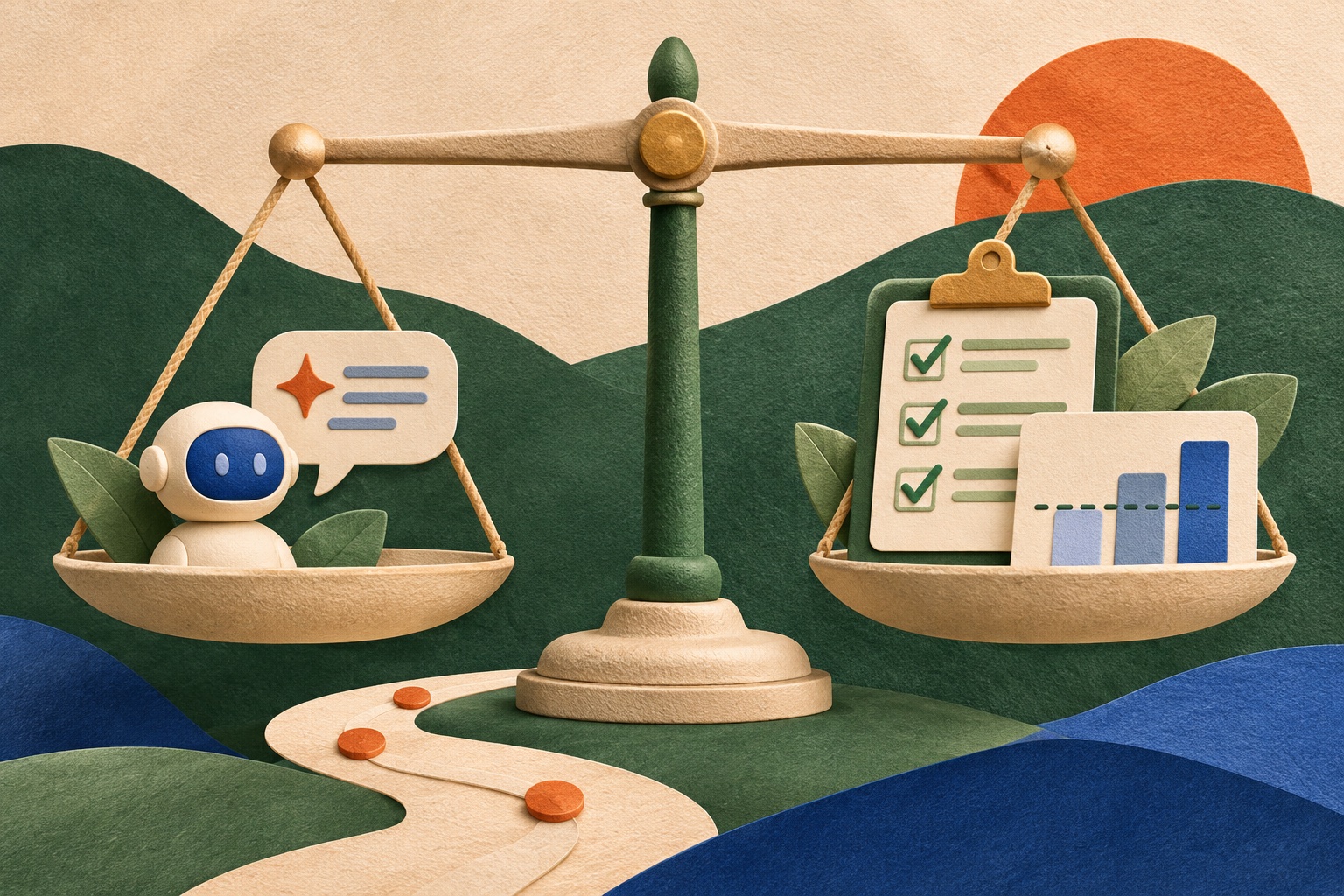
A convincing prototype can answer the wrong question beautifully. Before promising that AI will save time or improve service, define the task, a comparison point, and the evidence that would make you stop. This guide turns an AI idea into a testable business decision.
Write the job and boundary in plain language
Name the user, input, output, and decision the system supports. List what it must not decide or do. “Help the service team classify incoming requests” is testable; “transform customer operations” is not. Decide how a person handles missing, sensitive, or ambiguous inputs. Power Automate approvals.
Check whether a conventional rule, search, interface improvement, or workflow change could solve the same problem with less operational burden. The correct comparison may not be another AI model.
Build a baseline and representative set
Measure the current process: time, quality, rework, and outcomes that matter to users. Create examples across ordinary, edge, and high-risk cases, with expected outcomes reviewed by people who know the work. Keep the test set separate from prompt tweaking where practical.
Evaluation is a repeated process: state criteria, run the same cases, inspect errors, and compare versions. A few polished demonstrations are not a reliable sample of live performance.
Include the human and system costs
Count review time, exception handling, integration, privacy and security controls, model usage, and ongoing evaluation. A tool can reduce drafting time while increasing correction work. Track both so the pilot does not hide transferred effort. See also OpenAI evaluation best practices.
For agents and connected workflows, limit permissions and allowed actions. Prefer reversible operations, logs, and explicit approval for consequential decisions.
Set decision gates before results arrive
Agree on minimum quality, acceptable error types, user feedback, cost, and a rollback condition. Decide who can authorize expansion and who monitors the live system. If results miss the bar, narrow the task, add a human checkpoint, or stop.
Describe findings with limits: which tasks were tested, on what data, and under what supervision. The most credible outcome may be that a smaller use case is appropriate—or that no AI is needed.
What would you do?
What result would make you stop an AI pilot even if the demo looked impressive? Share your experience in the comments.
Have a related project in mind? Talk with Acorn.
Share your perspective